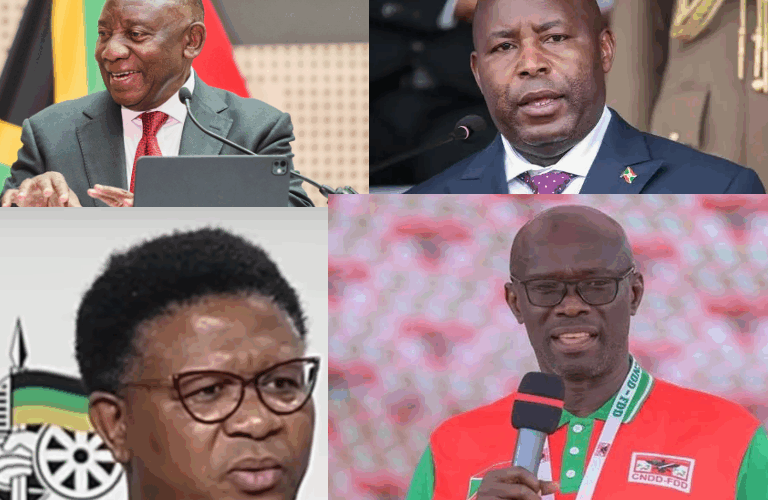
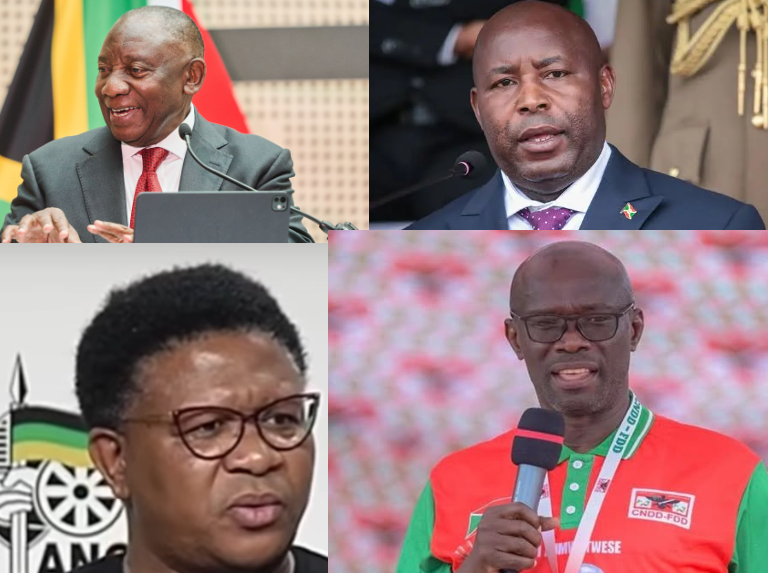
The ANC in South Africa and the CNDD-FDD in Burundi are two former liberation movements that came to power in 1994 and 2005, respectively. Both led political transitions, but a decolonial analysis reveals that they did not fundamentally challenge the structures of « coloniality. » Their governance, marked by a formal rupture yet structural continuity, raises questions about the conditions for genuine emancipation in post-independence Africa.
Gitega, 4/08/2026 (BDIAGNEWS) — South Africa has been confronted with « the Cross and the Banner » since the 17th century: that is, the Dutch Reformed Church and Dutch settlers (the Netherlands) from 1652 onward; then, from 1814, Great Britain, along with a diversity of Protestant missions (Anglican, Methodist, Presbyterian) and Catholic ones (Oblates of Mary Immaculate, Dominicans, Trappists of Mariannhill, Benedictines). Burundi, for its part, has been confronted with « the Cross and the Banner » since the late 19th century: that is, the Vatican (notably the White Fathers), France, England, Germany, Belgium (after 1916), and the United States (after 1945). These, then, are the colonial legacies of these two countries — their respective colonialities.
In South Africa, political organization long predated the arrival of the colonists. Among Black peoples, governance was exercised through lineage chiefs, who managed the affairs of the people according to customary principles and marital or military alliances. It was with the proclamation of the Union of South Africa in 1910, under British domination, that the modern form of political parties was introduced as an instrument of colonial administration. It was within this framework that the South African Native National Congress (SANNC) was born on January 8, 1912, in Bloemfontein, in the Orange Free State. This movement was the first national political organization of Black South Africans, created in response to the exclusion of indigenous populations from the new unionist state. Renamed the African National Congress (ANC) in 1923, it would become the spearhead of the struggle against apartheid.
In Burundi, the phenomenon is similar but occurred later. Before colonization, political alliances were built through the miryango (lineages), embodied in alliance totems. It was only on the eve of independence, through a Belgian colonial decree of December 25, 1959, that the political party form was imposed, paving the way for electoral competition modeled on the Western pattern. It was in this context, well after independence in 1962, that the National Council for the Defense of Democracy (CNDD) was born in 1994, at the height of the civil war. This armed resistance movement was accompanied by its military wing, formed in 1993–1994, the Forces for the Defense of Democracy (FDD), nicknamed Intagoheka (« those who never sleep »), in reference to their vigilance and unrelenting commitment. In 1998, the movement took the name CNDD/FDD, before becoming, in January 2005, a legal political party, the CNDD-FDD, which won the elections a few months later.
The rise to power of the African National Congress (ANC) in South Africa (1994) and of the National Council for the Defense of Democracy – Forces for the Defense of Democracy (CNDD-FDD) in Burundi (2005) embodies the victory of movements long excluded from power. The ANC, after decades of struggle against apartheid, and the CNDD-FDD, after a civil war against a military dictatorship, both promised a refounding of their societies. Yet a retrospective analysis, from the standpoint of decolonial studies, invites us to question the depth of these transformations: did these parties truly break with the colonial legacy, or did they, in a sense, « keep colonial History and tradition » by preserving the fundamental structures of the state, the economy, and power?
From the moment they took office, the ANC and the CNDD-FDD initiated reforms, breaking with the previous regimes on the legal and political level.
The ANC abolished the apartheid laws and promoted a « Rainbow Nation. » Its project, implemented in 1994, the Reconstruction and Development Programme (RDP), linked to its vision drawn from the 1955 Freedom Charter, was embodied in one of the world’s most progressive constitutions (1996), guaranteeing extensive civil, political, and social rights. However, its neoliberal economic turn (the GEAR plan, 1996) was perceived by some as a concession to international financial institutions, favoring macroeconomic growth at the expense of a radical redistribution of wealth. The National Development Plan (NDP) – Vision 2030, though ambitious, has struggled to materialize.
The CNDD-FDD, for its part, developed a societal project from its time as a rebel movement, formalized notably in the document of the Permanent Commission for Political Studies (COPEP) of July 2001. This « Profile of Post-War Burundian Society » aimed to break with the authoritarian centralism of previous regimes in order to establish a decentralized and participatory democracy, founded on subsidiarity. It envisioned a modernization of the socio-economic system, encouraging entrepreneurial spirit and modern territorial management, in step with the neoliberal context of the time. Today, the Burundian state has developed and implemented a project, the « Vision 2040–2060. »
Despite rhetoric of rupture, the ANC and the CNDD-FDD have preserved the fundamental structures inherited from colonization.
In the realm of the state, both parties maintained a centralized republican nation-state model. In South Africa, the ANC inherited the centralized administration of apartheid without challenging its fundamental architecture. In Burundi, the CNDD-FDD even reinforced this centralism by reducing the number of provinces in 2023, a reform that increased central power’s control over the territories.
Economically, the ANC made a clear choice by adopting a capitalist market economy, with an explicit neoliberal turn through the GEAR plan in 1996. The CNDD-FDD, for its part, framed its modernization project within the neoliberal context of the 2000s, as reflected in the 2001 COPEP document, which encouraged entrepreneurial spirit and microcredit. In both cases, the market economy inherited from colonization was never fundamentally called into question.
Regarding power, coloniality persists in various forms. In South Africa, one observes the persistence of a « racial ontology » within economic structures, where inequalities inherited from apartheid continue to shape access to wealth. In Burundi, since 1972–1973, the market economy has replaced the Ubumu (the thing of « Mu » Mukakaryenda, the Drum Woman), the name of the traditional Burundian socio-economic system. To this day, the market economy persists, with glaring social inequalities, accentuated by the CNDD-FDD’s political choice to anchor itself in neoliberalism.
Finally, in the realm of knowledge, epistemic coloniality remains pervasive. In South Africa, the education system and knowledge production remain largely structured by Western models, often relegating indigenous knowledge to the margins. In Burundi, the situation is the same in education; added to this are law, administration, and modes of governance, which still bear the imprint of the Belgian legacy, as not all colonial laws have been repealed and administrative practices retain logics inherited from the colonial period.
Thus, while both parties carried out formal political ruptures — the ANC by abolishing apartheid, the CNDD-FDD by ending the military-civilian dictatorship — they did not, in practice, decolonize the deep structures of the state, the economy, power, and knowledge. Coloniality persists, and with it, the relations of domination that stem from it.
The handling of ethnic or « racial » (Black/white) questions illustrates a paradoxical appropriation of the colonial legacy.
The ANC and « affirmative action »: in South Africa, the ANC implemented « affirmative action » policies to correct the imbalances of apartheid. These policies are contested, with some viewing them as a mere « deracialization of the elite » that does not challenge the fundamental economic structures.
The CNDD-FDD and the Arusha quotas: in Burundi, the CNDD-FDD vigorously criticized the Arusha Accords, which institutionalized Hutu-Tutsi quotas, seeing in them an « ethnicization » imposed from outside.
This constitutes an instrumentalization, by coloniality, of the « neocolonial geopolitical racist tool of the Hutu-Tutsi interethnic conflict » put in place by Hans Meyer in 1911. However, once in power, the CNDD-FDD never called these ethnic quotas into question, thereby placing the country back under coloniality.
This instrumentalization of identities reveals a persistence of the power logics stemming from colonization, which divide and hierarchize society. The political use of ethnicity or race, far from being decolonized, has been repurposed to serve new relations of domination.
The gap between discourse and governance practices is another indicator of the persistence of coloniality.
The ANC, despite its constitutional commitment to democracy, has been criticized for systemic corruption under the presidency of Jacob Zuma (the phenomenon of « state capture ») and for a tendency toward the centralization of power.
The CNDD-FDD, after promising decentralized governance, established a one-party regime. The party controls 96.5% of the seats in the National Assembly, eliminating all parliamentary opposition.
This evolution suggests that « decolonization » was not conceived as a political process involving the transformation of institutions and the redistribution of power, but rather as a takeover of the inherited state. The CNDD-FDD’s original societal project was thus supplanted by a logic of « state capture, » as was the case for the ANC under certain of its factions.
The experience of the ANC and the CNDD-FDD shows that the rise to power of former liberation movements does not guarantee full emancipation from the structures of coloniality. While the formal ruptures (Constitution, laws) are real, the structural continuities (centralized state, dependent economy, authoritarian power logics) persist.
The challenge for these countries, and for Africa, may be to rethink decolonization not merely as a transfer of political power, but as a deep process of reclaiming knowledge, institutions, and economies. This implies, as an Afrofuturist perspective suggests, « laying one’s history and tradition at one’s own feet in order to live the present in the future » — that is, inventing models of society no longer imprisoned by inherited frameworks. Neither the ANC nor the CNDD-FDD has, to this day, succeeded in meeting this challenge.
Thus, certain intellectuals speak of a « coloniality of power and knowledge » — in South Africa, Danielle Becker (University of Cape Town) or Lehasa Moloi (University of South Africa – UNISA); in Burundi, Nahimana Karolero. Coloniality of power refers to structures of economic power (market capitalism) and political power (the centralized nation-state) regarded as colonial legacies, since they were imposed and institutionalized by European domination — that is, « the Cross and the Banner. » Coloniality of knowledge refers to knowledge production, academic methods, and the « interpretive frameworks » of the world that remain marked, in both South Africa and Burundi, by Western epistemic hegemony. To think about the future is also to think with concepts and within frameworks that are often imported.
In this new era of a multipolar world, that of the BRICS+ (of which South Africa is a member), these intellectuals propose an « epistemic Bandung, » that is, a dynamic enabling the acquisition of an active historical consciousness. For them, this involves reconnection and solidarity among the peoples of the Global South (Africa, Latin America, Asia), enabling them to produce, together, knowledge and futures no longer dependent on the Western center. This is precisely the idea of an « Afrofuturism » which, by reclaiming its history and tradition, can invent the future while adapting — but from its own foundations.
South Africa and Burundi are former territories of Drum-States (Ingoma); they are also clusters of peoples or lineages belonging to Ubungoma, the cosmology of the Drum, arising from the Civilization of the Drum. In Burundi, the Republic-State (the political, state institution) must lay at its own feet its foundation, the Drum-State, Ingoma, with the Karyenda (the sacred institution of the Drum) based at the Buryenda palace, comprising the structure (an organ) of the Bataka (the umbrella-bearers) or Bakuru, that of the chiefs of each lineage (umuryango) present in Burundi. This structure of the Bataka ensures a permanent dialogue with the chief of all the Barundi, that is, the Head of State. The Burundian socio-economic system, currently a neoliberal market economy, must lay at its own feet its foundation: the Ubumu, a socio-economic planning meant to enable each muryango (that is, each Murundi) to meet its resource needs.
References
– Baranyanka, Charles. Le Burundi face à la Croix et à la Bannière [Burundi Facing the Cross and the Banner]. Brussels, 2015. (The expression « the Cross and the Banner » refers to the historical alliance between the Vatican, France — notably via Lavigerie’s White Fathers —, England, Germany, Belgium, and the United States against the traditional Burundian order since the 19th century.)
– Kentey Pini-Pini Nsasay. Tribunal de l’Histoire africaine, Tome 1: Réquisitoire contre l’Europe christianisée [Tribunal of African History, Volume 1: Indictment of Christianized Europe], in tribute to E. D. Morel (1873–1924/2024). Historiographie du Monde contemporain Collection. Douala: Éditions Cheikh Anta Diop (Edi-CAD), 2024.
– Kentey Pini-Pini Nsasay. Croisades de l’Europe christianisée contre l’Afrique ancestrale, Tome II – La guerre permanente en Afrique [Crusades of Christianized Europe against Ancestral Africa, Volume II – The Permanent War in Africa]. Afric’Avenir, 2018.
– Kentey Pini-Pini Nsasay. Croisades de l’Europe christianisée contre l’Afrique ancestrale, Tome I – Procès du christianisme meurtier [Crusades of Christianized Europe against Ancestral Africa, Volume I – Trial of Murderous Christianity]. Afric’Avenir, 2017.
– Kentey Pini-Pini Nsasay. La mission civilisatrice au Congo – Réduire des espaces de vie en prison et en enfer [The Civilizing Mission in the Congo – Reducing Living Spaces to Prison and Hell]. Afric’Avenir, 2012.
– Mandela, N. (1994). Long Walk to Freedom: The Autobiography of Nelson Mandela. Little, Brown and Company.
– Pahad, A. (2014). Insurgent Diplomat: Civil Talks or Civil War?. Penguin Books.
– Meli, F. (1989). South Africa Belongs to Us: A History of the ANC. Bloomington: Indiana University Press.
– Moloi, L. (2020). This study deployed the theory of Afrocentricity as a revolutionary epistemic and methodological framework relevant to challenging the dominance of Eurocentrism in the conception of development as an ideology, process and… (unpublished dissertation). University of South Africa.
– Moloi, L. (2024). Developing Africa? New Horizons with Afrocentricity. Anthem Press.
– Becker, D. (2019). Afrofuturism and Decolonization: Using Black Panther as Methodology. Image and Text: A Journal for Design, 1(32), 1–21.
– Becker, D. (2022). Afrofuturism and Animism as Method: Art History and Decolonisation in Black Panther. In M. Gray & I. Horton (eds.), Seeing Comics through Art History: Alternative Approaches to the Form. Palgrave.
– Nahimana Karolero, Pascal. Histoire du Burundi: Les grandes dates de l’histoire des Barundi et de l’État millénaire africain – Ingoma y’Uburundi [History of Burundi: Key Dates in the History of the Barundi and the Millennial African State – Ingoma y’Uburundi]. Brussels: Génération Afrique, 2024. 🔗 nahimanakarolero.com
– Nahimana Karolero, Pascal. Réfugiés du Burundi — Quand Ingoma s’est tu. Histoire géopolitique d’un peuple brisé par la colonialité [Refugees of Burundi — When Ingoma Fell Silent. A Geopolitical History of a People Broken by Coloniality]. Brussels: Génération Afrique, 2025. 🔗 nahimanakarolero.com
– Nahimana Karolero, Pascal. La guerre civile du Burundi (1993–2003). Face à la globalisation unipolaire américaine néolibérale, le CNDD-FDD [The Burundian Civil War (1993–2003). The CNDD-FDD Facing Unipolar American Neoliberal Globalization]. Brussels: Génération Afrique, 2024.
– Nahimana Karolero, P. (2026). Histoire des imiryango: Les Bajiji — Abajiji, Bajiji, Wajiji, Jiji: Du Burundi au Mwene Mwezi: À l’origine de l’Ubungoma, d’Ingoma et de l’Ubumu: Cosmologie, État et système socio-économique du tambour sacré [History of the Imiryango: The Bajiji — Abajiji, Bajiji, Wajiji, Jiji: From Burundi to Mwene Mwezi: At the Origin of Ubungoma, Ingoma, and Ubumu: Cosmology, State, and Socio-Economic System of the Sacred Drum]. Génération Afrique. (nahimanakarolero.com)
– Kubwayo, F. (2026). Le regard rétroactif du Burundi politique [The Retrospective Gaze of Political Burundi]. Brussels. (See the Burundian planning tradition — Ubumu.)
– Sindayigaya, J.-M. (1998). Grands Lacs: Démocratie ou ethnocratie? [Great Lakes: Democracy or Ethnocracy?]. L’Harmattan.
– Sindayigaya, J.-M. (2000). Mondialisation: Le nouvel esclavage de l’Afrique [Globalization: The New Enslavement of Africa]. L’Harmattan.
– Sindayigaya, J.-M. (2002). La saga d’Arusha [The Saga of Arusha]. Association de Réflexion et d’Information sur le Burundi, ARIB.
– Sindayigaya, J.-M. (2023). Renaissance de l’Afrique par les valeurs de l’Africanité-Ubuntu [The Rebirth of Africa through the Values of Africanity-Ubuntu].
– Sindayigaya, J.-M. (2023). African Rebirth by the Values of Africanity-Ubuntu: The Unity of Africa, a Question of Life or Death.
– Sindayigaya, J.-M. (2023). Ufufuo wa Afrika kupitia maadili ya uafrika-ubuntu [The Rebirth of Africa through the Values of Africanity-Ubuntu, Swahili edition].
Sources : Nahimana P. , BDIAGNEWS: burundi-agnews.org | Tuesday, August 4, 2026